


ANDEAN LAKES II: PUERTO VARAS

Updated: Aug 18, 2025

Viewpoint on Costanera Avenue, with Lake Llanquihue and, in the background, volcanoes Osorno (left), Calbuco (right) and Cerro Tronador (center).
So, as I said in the last post, the years passed by, the marriage came to an end, others have come and life went its own way. I could travel more, in and out of Brazil and I met new places and people. Inevitably, in my conversations, friends, knowing of my passion for traveling, and following my stories (some of which I think it should be very tiring) always asked my opinion about which place among my wanderings was the most beautiful. My first impulse was always to answer that it was the Andean Lakes region.
But the more that 1995 trip was behind in time, the greater was my inner doubt when it came to answering - even though the answer to my friends was invariably the same. Until twenty years later, in 2015, when a new companion (the most traveler of all I have ever had) was the incentive for the "scientific expedition" to check if my first impression was correct or if it was just a betrayal of my affective memory.
Now much more experient, with a little more money and also with more time, I prepared a meticulous itinerary. Starting in Santiago de Chile, on December 28, 2015, before traveling through the Lake District, we went to the little town of Peñaflor, where my friend Marta Cid lives, to Valparaíso and Viñadel Mar, where we spent New Year's Eve, crossed the border to Argentina, where we spent a few days in Mendoza and Maipú, and returned to the Chilean capital (about this part of the trip I am going to tell in other post).
From Santiago, on the evening of January 10, we made the longest and most tiring journey of the trip, from Santiago to Puerto Varas, the first city of our itinerary through the Andean Lakes region. I had a very vague memory of this little town thanks to a stop that must have lasted no more than ten minutes on my 1995 trip from Osorno to Puerto Montt. This very short entrance into the city, however, had been enough to show me that Puerto Varas was charming. The pictures that I saw during these twenty years of waiting only confirmed that first impression left by my meteoric passage there.
I didn't regret it. On the opposite, Puerto Varas is a charming and cozy city framed by the stunning Llanquihue Lake and the magnificent Osorno Volcano, making any photo, taken from any angle, on a clear day, worthy of a postcard (when they still existed...) or a calendar (another domestic object increasingly rare...).

Nightfall at Lake Llanquihue, with the Osorno Volcano in the background.
On this trip, which, as I said, began in Santiago, I used the Airbnb lodging service for the first time. In Puerto Varas, we rented a room at El Roble Hostal, a super cozy house that we shared with the owners and another couple from Buenos Aires, Ricardo and Patricia, university professors, who became our friends and whom we met the following year in the Argentine capital. Besides the excellent breakfast and the privileged view of the Osorno Volcano, as a bonus our host, Martin, invited us to sing on Wednesday nights, when popular Chilean music, Argentinian music and even Brazilian Popular Music were played.

Our host, Martín, and Ricardo, a guest like me, at a musical soirée at Hostel Los Robles
Besides having its own enchantments, such as the beautiful Church of the Sacred Heart of Jesus, Puerto Varas also served as a base for three round trips: Frutillar, a flowery little town 28.5 km north, also on the shores of Lake Llanquihue and with a spectacular view of the Osorno Volcano; Valdivia, a beautiful university town about 200 km further north, passing through Osorno almost halfway; and Puerto Montt, 20 km south, from where we extended to Castro, the main city of the Chiloé archipelago. From each of these short but intense trips we brought back in our memories smells, flavors, but mainly unforgettable images.

Puerto Varas: Osorno Volcano

Puerto Varas: Sacred Heart of Jesus Church

Frutillar: Marcia, my wife, in a garden on Philippi Ave.

Frutillar: the beautiful wooden structure of the Teatro del Lago

Valdivia: Mercado del Pescado seen from the Calle-Calle River

Valdivia: tourist boat crossing the Calle-Calle River

Castro, Island of Chiloé: San Francisco Church seen from behind

Castro: Luis Oribe Díaz School Gymnasium
Translated by Laura Vieira
I returned to Puerto Vargas once again in January 2025, and this time I discovered other must-see attractions. Since this blog isn't intended to be a tourist guide, but rather a collection of memories from a traveler, I'm including the ones I found most relevant.
PABLO FIERRO MUSEUM
I'll start with a fantastic place: the Pablo Fierro Museum. Created by the artist whose name it bears, it's a charming blend of house museum, art gallery, and living memory space.

Founded and maintained by Pablo Fierro himself, the museum arose from his desire to preserve and celebrate the history of the region's settlers, especially the influence of German immigration and Chiloé traditions. Fierro built and decorated the space with antique objects, paintings, furniture, and household items that evoke the city's recent past and Chilean family life. The museum is known as a "space of memory and dreams," where every corner tells a story and each piece holds an emotional meaning. You'll hardly leave without carrying in your memory and heart the image of an antique object, probably from your childhood, from your grandmother's or an aunt's house, a reproduction of Pablo Fierro's watercolors, and, most likely, dozens of photographs—and, if you're lucky, at least one of them with the artist, architect, curator, and museum owner himself.

Its most striking features are its eccentric and captivating facade, filled with architectural and decorative elements that catch visitors' attention from the street; its interactive interior, where visitors are encouraged to touch the objects, making the experience sensorial and personal; and Fierro's paintings, depicting old mansions and local landscapes using a variety of techniques. Furthermore, I especially highlight the museum's welcoming atmosphere. Fierro is often present, sharing stories and chatting with visitors, which makes the visit even more special. I also highlight the panoramic view from the second floor, from which you can admire Lake Llanquihue and the majestic Osorno Volcano.

Admission is free, with a voluntary contribution, and the museum is open Tuesday through Sunday, starting at 11:30 a.m. If you enjoy places that blend art, history, and emotion, the Pablo Fierro Museum is a must-see.
PASSAGE RICKE
Located near the city center, at the intersection of Calle Diego Portales and the beginning of Calle Estación, this quiet street is surrounded by a variety of services and attractions that reflect the region's welcoming and touristy spirit. It is home to several hostels and guesthouses, such as Hostal Vermont and La Guapa Hostel, ideal for travelers seeking comfort and proximity to the center. Just a few meters away are the Puerto Varas Cultural Center, the Santa Rosa Shopping Center, and the famous El Patio de Don Enrique, offering cultural and gastronomic options. Like much of Puerto Varas, the region is strongly influenced by German colonization, visible in the buildings and urban layout—architecture, in fact, depicted in several of Pablo Fierro's paintings.
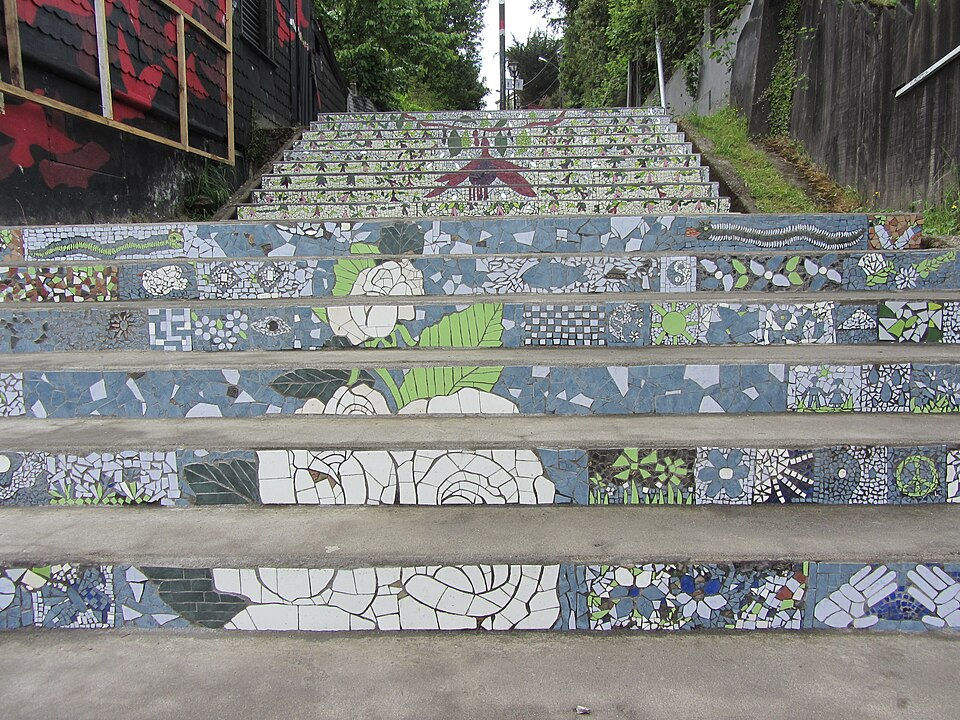
Pasaje Ricke is ideal for those who want to explore Puerto Varas on foot, with easy access to the coastline of Lake Llanquihue and stunning views of the Osorno Volcano. It's a street that combines residential tranquility with the city's tourist vibe. It's also a pedestrian thoroughfare that provides access to Calle Klenner, where Parque Estación Puerto Varas is located.

Pasaje Ricke begins with a staircase, with the beautiful Taberna Nosé building to the left. The staircase is covered in a collective mosaic created in 2013 by the Fundación Carnaval del Sur as part of an artistic and heritage project for the city. Since then, the staircase has become a cultural symbol, with mosaics representing the biodiversity and identity of southern Chile. In 2021, following damage caused by emergency work by Essal, the company responsible for Puerto Varas' water and sewage services, an agreement was signed between the municipality, the foundation, and the company to rebuild and restore the mosaics. The replacement was completed and reopened in January 2023, with the participation of the local community, including students and artists.
PUERTO VARAS PARKING STATION
Puerto Varas Station Park is a vibrant urban space located in the heart of the city. Built on the site of the former railway station, the park emerged as a response to the scarcity of public spaces amid rapid urban expansion. Since its founding, led by Fundación Parque Sur, the project has promoted the restoration of historical heritage, the expansion of green spaces, and the strengthening of community life.

Today, Parque Estación is a cultural and social meeting point, with activities such as fairs, open-air cinema, and community events. Furthermore, it represents a model of participatory and sustainable management, considered a driver of urban development and active citizenship. If you're on foot and decide to explore Pasaje Ricke, Estación Puerto Varas is at the end. If you're driving, the best route is Calle Estación until you reach Calle Klenner on the right.
Of course, there's much more to see in Puerto Varas and the surrounding area. Not to mention the wonderful cuisine and variety of wines. Both times I've been there, I left feeling like it would have been worth staying a few more days. But that's perhaps more of an incentive than a regret.


Comments