


THE LUMINOUS COIMBRA


If it were a Brazilian city, Coimbra would be considered small. Among Brazil's 5,570 municipalities, the seven cities that occupy an area roughly equivalent to Coimbra—319.4 km²—are ranked 3,298th to 3,304th. Also regarding population density, Coimbra, with just under 441 inhabitants/km², would be considered average, as cities with equivalent population densities occupy positions 2,683rd to 2,686th in the Brazilian ranking.
It turns out that, besides considering Portugal's tiny size—which could fit 92 times inside Brazil—and its population of only 10.4 million, I must remember Coimbra's historical and cultural importance. Among other things, I remember that Coimbra was the capital of Portugal before Lisbon, starting in 1131, when King Afonso Henriques transferred the seat of the County of Portugal from Guimarães there, and was instrumental in the founding of the Kingdom of Portugal in 1143. Coimbra was, therefore, the national capital of Europe, as Portugal is considered to have become the first European nation state. Furthermore, the University of Coimbra, one of the city's main tourist attractions, is among the oldest universities in the world and is the European university that receives the most students from other countries. For that reason alone, I think it's worth visiting "Coimbra, where once with tears the story of that beautiful Inês was made," as an old song by Raul Ferrão with lyrics by José Galhardo goes, considered an informal anthem of the city. Shall we take a look? Oh, and about the beautiful Inês, I won't give any spoilers now, okay?
HOW TO GET THERE?
Coimbra is located halfway between the capital, Lisbon, and Porto. If you're staying in Porto, the trip to Coimbra will take a maximum of 1 hour and 30 minutes. If you're coming from Lisbon, it will take a maximum of 2 hours and 30 minutes. My most recent trip to Coimbra departed from Castelo Branco ( see here ). I took a comboio (train), which took that time to get there. In short, getting to Coimbra is relatively quick and easy.
THE OLD TOWN AND HISTORICAL MONUMENTS

To explore Coimbra, I suggest starting at Largo da Portagem . The central square of the city, it is home to important access routes to the so-called Old City. One of its most iconic landmarks is the statue of politician Joaquim António de Aguiar (1792-1874), made by sculptor António Augusto da Costa Mota (his uncle). Born in Coimbra, Joaquim António de Aguiar served as minister several times, serving as President of the Council of Ministers of Portugal three times. In 1834, while Minister of Ecclesiastical Affairs and Justice, he became famous for promulgating a law that declared the abolition of "all convents, monasteries, colleges, hospices, and any other houses of regular religious orders," ordering the secularization of all their assets, which were incorporated into the Portuguese National Treasury. Due to his anti-ecclesiastical spirit, Joaquim António de Aguiar became known as the “Mata-Frades” (Friar Killer).
Regarding the sculptor Costa Mota, it's important to point out that the "uncle" after his name is intended to prevent us from making the mistake of giving credit to the wrong sculptor. Costa Mota had a nephew with the exact same name and who was also a sculptor. His most famous sculptures, in fact, are in the Portuguese capital, notably the tombs of the poet Luís de Camões, author of the epic poem The Lusiads, and the navigator Vasco da Gama, the first European to discover a sea route to Asia, both located in the Jerónimos Monastery in Lisbon, which I've already discussed here .
Still in Largo da Portagem, it's worth noting the architecture surrounding the square, highlighting two buildings that are among Coimbra's most iconic. Perhaps the most famous is the Hotel Astória , opened in 1926 and designed by architect Adães Bermudes. This architect had previously designed the neighboring building, the headquarters of the Bank of Portugal , in 1907.
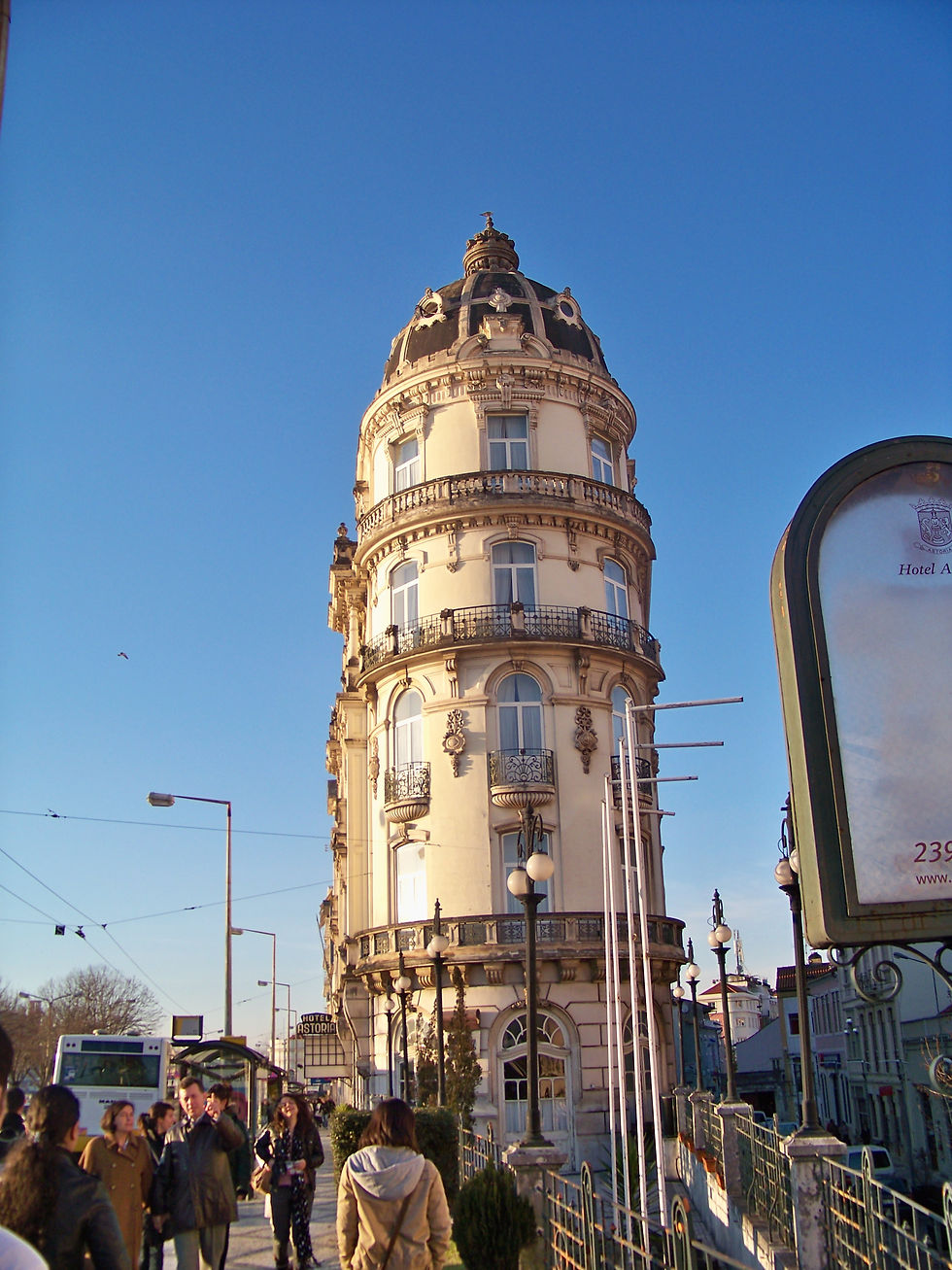

Largo da Portagem is where Rua Ferreira Borges begins , a rua pedonal (pedestrian street, in Portuguese) lined with cafes, bars, restaurants, and shops. I'd like to highlight, right at the beginning, Livraria Bertrand , a must-see for anyone who loves a good read and, like me, still has a fetish for the smell of a good, brand-new book.


Photo: Rafal K.
Next door is the equally indispensable Pastelaria Briosa (Brilliant Pastry Shop). In fact, the rather understated façade doesn't even begin to hint at the wonders you'll find within. As soon as you enter, you're immediately captivated by both the welcoming atmosphere and the delicious aroma of pastries and fresh coffee. To top it all off, the charming tables, old photographs of Coimbra, soft lighting, and background music make Pastelaria Briosa a delicious slice of paradise. Perhaps it's best not to start your tour there, but rather save it for the end of the day, as it's the ideal place for a relaxing and delicious break after a few hours of walking.

Continuing on Ferreira Borges, you'll find a pleasant jumble of craft and souvenir shops, pharmacies, jewelry stores, banks, and all sorts of commercial establishments. The route is quite short, about 250 meters. At the end, you'll find the Escadas de São Tiago (St. James Steps) on the left. Descending these steps, you'll reach Praça do Comércio (Shopping Square), where the Church of São Tiago stands. Built between the late 12th and early 13th centuries, it is considered one of the city's great Romanesque monuments. In fact, this building has undergone several modifications over the centuries, the most significant in 1861 for the widening of what is now Visconde da Luz Street, but it's still worth a visit.

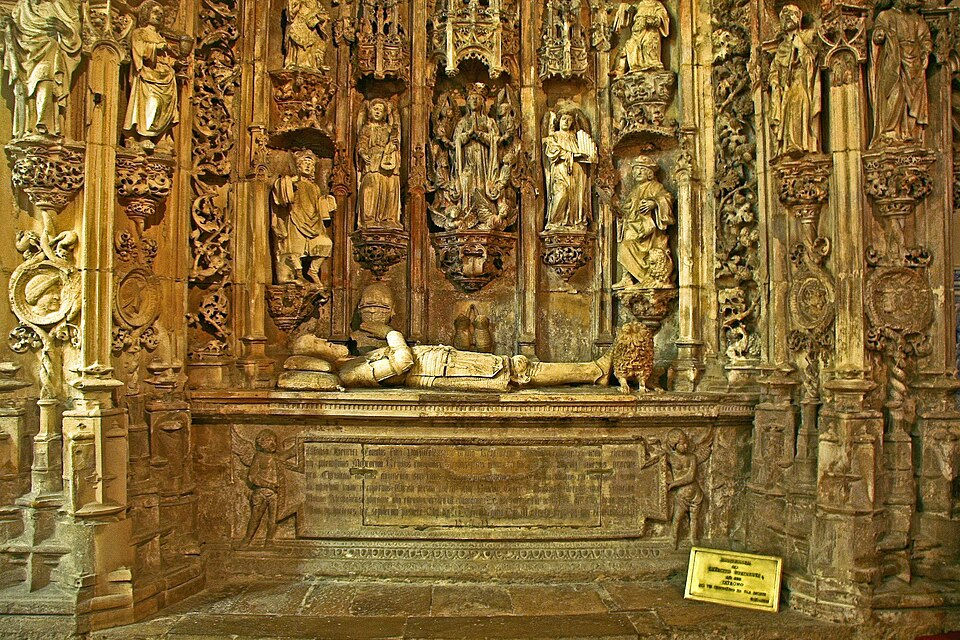
Going back up the St. James Steps, on the left is Visconde da Luz Street —actually a continuation of Ferreira Borges Street—with more shops, perhaps geared more toward the locals . At the end of it is the tranquil 8 de Maio Square , home to the Santa Cruz Monastery , located between Coimbra City Hall and Café Santa Cruz. Founded in 1131, during the reign of D. Afonso Henriques, the first king of Portugal, it belonged to the Order of Canons Regular of Saint Augustine.
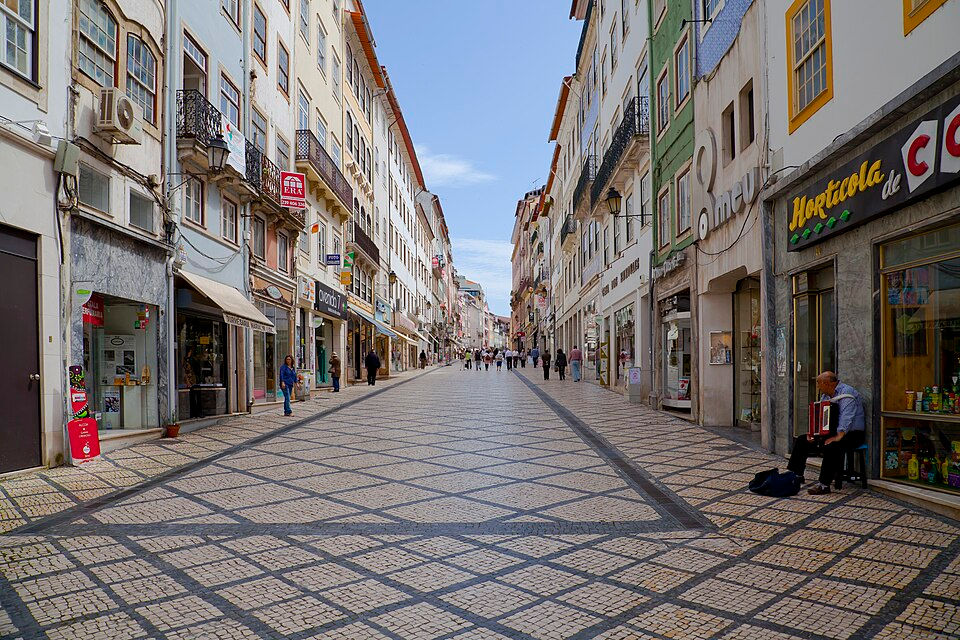
Photo: Diego Delso (2012)


Photo: Vitor Oliveira (2019)

The Monastery of Santa Cruz was the most influential monastery in the city and the country. Furthermore, there is evidence that Saint Anthony (1195-1231) and the great Portuguese poet Luís de Camões (1524-1580), author of the epic poem The Lusiads, studied there, as the Monastery of Santa Cruz operated a school that was considered one of the finest educational institutions in medieval Portugal for theological studies. At the time, a relative of the poet, Dom Bento de Camões, was prior of the monastery. Santa Cruz also had a large library and a scriptorium (a space where handwritten books were produced during the Middle Ages).
In addition to all these facts, the Monastery of Santa Cruz is also an unmissable attraction for those interested in History because it is where the remains of D. Afonso Henriques (who died in 1185) and his son, King D. Sancho I (died in 1211) are buried.
To the right of the monastery is the historic Café Santa Cruz . It is one of Coimbra's most traditional cafés and restaurants, housed in the building of the Parish Church of São João de Santa Cruz , a former Manueline-style church built around 1530. With the abolition of religious orders in 1834, during the Pombaline Reformation (see more about it here ), the church was desecrated and became home to various commercial and government establishments, such as a hardware store, police headquarters, a fire department, and even a funeral home. Finally, in 1923, Café Santa Cruz opened, a café and restaurant with a neo-Manueline-style façade that remains to this day.

Next to the monastery building is the Coimbra City Hall, which has a rich and multifaceted history dating back to the 16th century. The current building is an imposing neoclassical structure built in the 19th century, between 1842 and 1848, during the reign of Queen Maria II, replacing the previous building on the same site, which was destroyed by fire. It's well worth a visit.

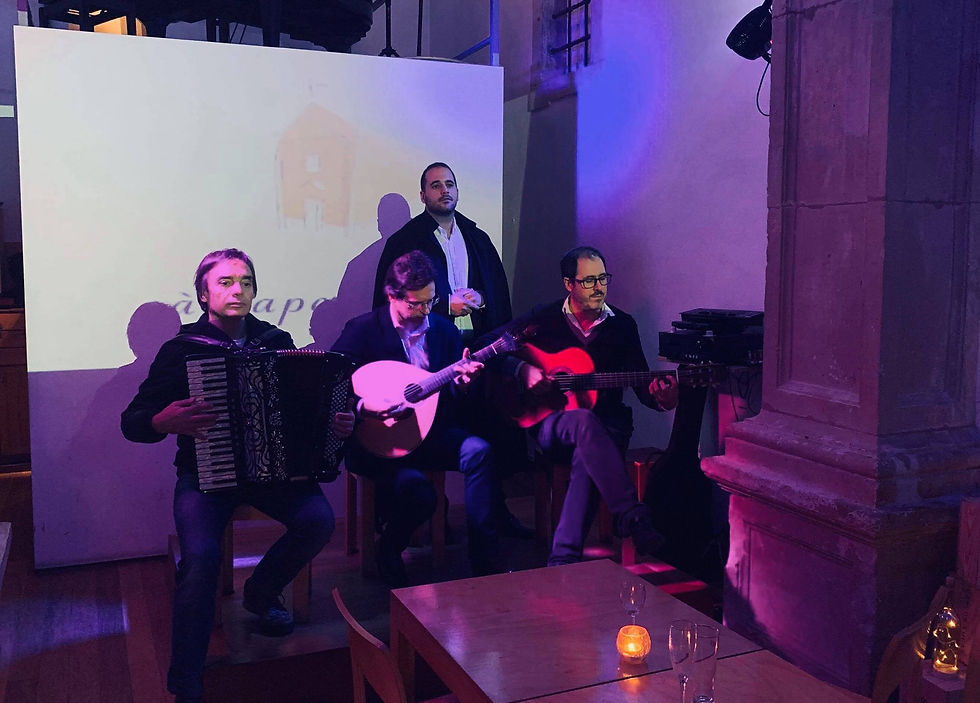
Returning to the end of Ferreira Borges, on the right is the iconic Rua do Corpo de Deus , a narrow, steep street with typical Coimbra characteristics. Near the end, there's a small slope to the left where you'll find the very interesting À Capella – Casa de Fados bar . As the name suggests, this place was actually a grand chapel – Capela da Victória, built in the 14th century – that was converted into a snack bar and a performance venue for fado, traditional Portuguese music.


If you walk to the end of this street and turn right onto Rua Colégio Novo , climbing a little further, you'll reach the Faculty of Psychology and Educational Sciences of the University of Coimbra . Since this blog isn't intended to be just a casual stroll, here's some information about the building's origins. This complex, which, in addition to the faculty itself, houses, in the adjacent ecclesiastical body, the church/archive/museum of the Misericórdia of Coimbra, was built to house the former Colégio de Santo Agostinho, also known as Colégio da Sapiência or Colégio Novo—a Renaissance college of the Cruzeiros (Canons Regular of Santa Cruz). Its foundation dates back to the mid-16th century and was already in operation by 1604. The church, in turn, was consecrated in May 1630, when the nave and chapel roofs were completed. It's worth popping in and taking in the bustling atmosphere of the college cloister for a few minutes before continuing on along Rua Coutinhos, a continuation of Colégio Novo, towards Sé Velha.
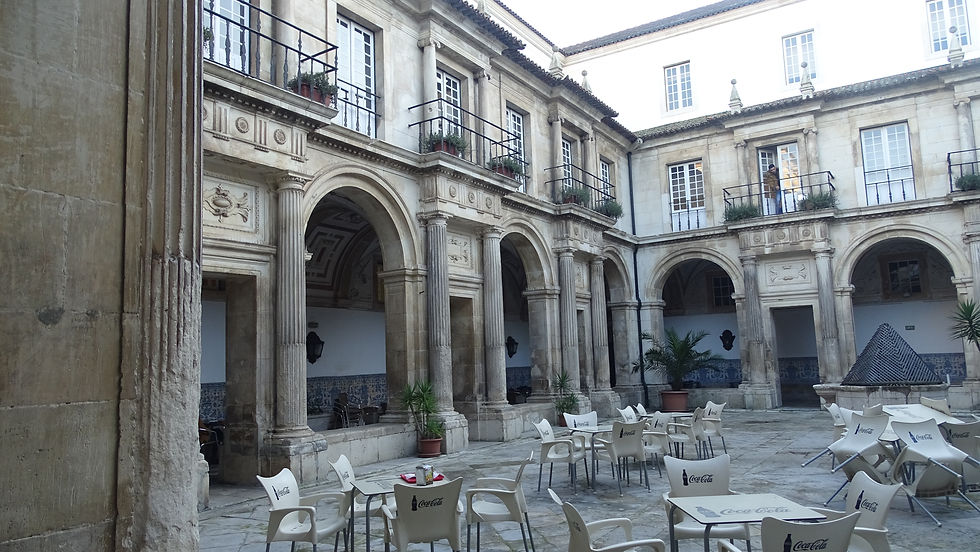

THE OLD CATHEDRAL
The Sé Velha (the Old Cathedral) of Coimbra is one of the oldest cathedrals in Portugal. Built in the 12th century, it is a Romanesque cathedral with an impressive façade and a richly decorated interior. Its massive, fortress-like façade conveys the idea of a defensive church, typical of the Reconquista period, with portals adorned with sculpted archivolts and a rose window illuminating the sober and austere interior. In the cloister, already in the Gothic style (13th century), the pointed arches create a sense of lightness and refinement, in contrast to the robustness of the temple. It was here that, in 1290, the consecration of the University of Coimbra was celebrated, making the building not only an architectural but also a historical landmark, as an example of the transition period between Romanesque and Gothic periods, and of Coimbra's role as the cradle of the Portuguese monarchy and culture.


MACHADO DE CASTRO NATIONAL MUSEUM
Another must-see attraction is the Machado de Castro National Museum , located in the former Episcopal Palace of Coimbra. One of Portugal's most important art museums, it surprises with the richness of its collection and the building's architecture. Built on the Roman cryptoporticus of Aeminium, one of the Empire's most notable underground structures, the museum invites visitors to journey through centuries of history through medieval sculptures, Renaissance paintings, jewelry, ceramics, and tapestries. In addition to the collections, the museum's terraces offer privileged views of the city, transforming the visit into an experience that unites art, archaeology, and landscape in a single space.
There are several ways to get to the museum, which is about 250 meters from the Old Cathedral. I suggest following Rua do Cabido to Beco das Condeixeiras, on the right, then following it to the end at Rua Borges Carneiro, turning left onto Largo Dr. José Rodrigues, where the museum entrance is located. The museum is open Tuesday through Sunday, from 10 am to 6 pm. Admission is free for children up to 12 years old, €5.00 for young people between 13 and 24, €10.00 for adults, and €5.00 for those over 65. Tickets can be purchased online. Residents of Portugal are entitled to 52 days of free admission per year to museums, monuments, and palaces, any day of the week. However, tickets, called "Access 52," can only be collected at the ticket offices of Portuguese museums and monuments.


UNIVERSITY OF COIMBRA
From the Machado de Castro National Museum, my suggestion is to take the narrow Travessa da Rua do Norte, skirting the building of the Faculty of Arts of the University of Coimbra . At the end of the street, turn left onto Rua do Norte and climb the approximately forty steps that form part of the street. You will find yourself in the heart of the University of Coimbra, where the historic monumental complex occupies the former medieval Royal Palace known as Pátio das Escolas (Schools' Courtyard). Converted into the institution's headquarters from the 16th century onwards, it was here that kings lived and political decisions that marked the history of Portugal were made, before the space became the country's most symbolic university center.
The Pátio das Escolas is surrounded by an imposing architectural complex, comprising administrative buildings, faculties, and a library, among which the University Tower , built in 1728 and visible from any part of the city, and the majestic Iron Gate , mark the gateway to centuries of knowledge and tradition. Walking through this enclosure is like entering a landscape that blends power, faith, and science, reflecting the long history of the university, founded in 1290 and considered one of the oldest in Europe.

Photo: Manuelvbotelho (2014)


Photo: Vladas Portapas
Among the most iconic buildings in the Pátio das Escolas is the Joanine Library , a true 18th-century Baroque gem, richly decorated with gilded woodcarving—an artistic technique widely used in Portugal, especially between the 17th and 18th centuries, which involves carving wood (the "carving") and then covering it with gold leaf—and boasting a collection of thousands of rare volumes. Next door is the Sala dos Capelos , the former throne room of the kings of Portugal, which is now used for the academy's solemn ceremonies, where tradition lives on in the rituals and attire of the students.

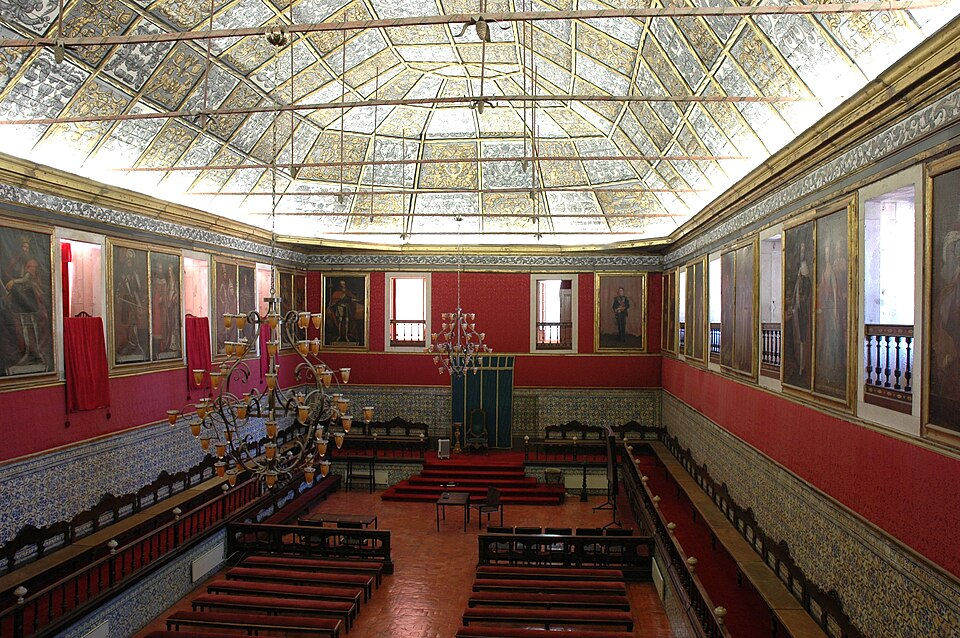
Before leaving the Pátio das Escolas, it's essential to enter the Chapel of São Miguel , a true treasure of Manueline and Baroque styles. Built in the 16th century, it enchants visitors with its magnificent Renaissance portal, the interior covered in 17th-century tiles, and the impressive Baroque organ, considered one of the most beautiful in Portugal. Despite its small size, the chapel is magnificent in its details.

The entire central core of the university was declared a UNESCO World Heritage Site in 2013, due to its universal cultural significance. For visitors, the space offers a unique journey through the history of Portuguese education, art, and architecture, in a setting that unites the splendor of the past with the vitality of the present.
BOTANICAL GARDEN
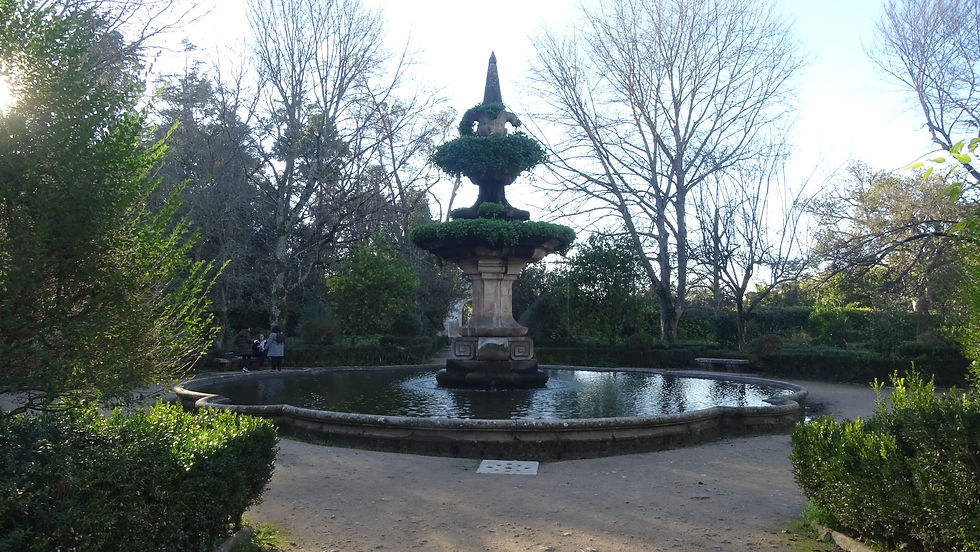
Leaving Pátio das Escolas, go around the General Library on Rua José Falcão, turn right onto Rua de São Pedro, and then turn left onto Rua Arco da Traição until you reach the entrance to the University of Coimbra Botanical Garden , the oldest botanical garden in Portugal. This green oasis offers a variety of exotic and local plants, as well as beautiful spots to relax and enjoy nature. Created in the 18th century to support the teaching of medicine and natural sciences, today the Botanical Garden offers a peaceful and extremely pleasant stroll among avenues shaded by century-old trees, tropical greenhouses, and ornamental gardens, where the diversity of species from around the world creates scenes of rare beauty.

DOCTOR MANUEL BRAGA PARK
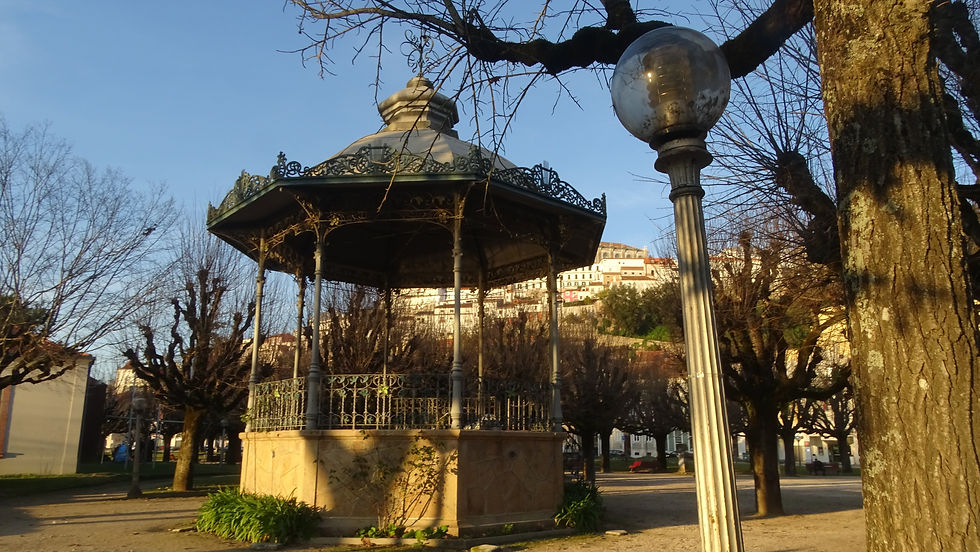
Returning to Largo da Portagem (preferably via Couraça de Lisboa), I suggest a stroll through the beautiful Dr. Manuel Braga Park , on the banks of the Mondego River. Along the way, among well-tended gardens and wide avenues, you'll enjoy a unique view of the historic city, with the University perched atop the hill. Along the way, you'll find cafes, terraces, and bike paths, as well as incredible views of the bridges and houses reflected in the river. The park is also filled with monuments to figures who were prominent in Coimbra's arts and culture, such as writer Antero de Quental and poet Florbela Spanca.


MONASTERY OF SANTA CLARA-A-NOVA
On the bank of the Mondego River, opposite the Old City, stands the Monastery of Santa Clara-a-Nova . Built in the 17th century, it replaced the old Monastery of Santa Clara-a-Velha, which was frequently flooded by the river's waters. Located on a hill with a privileged view of the city, the complex stands out for its imposing Baroque church and vast cloister, considered one of the largest in the Iberian Peninsula. One of the most important attractions inside the monastery is the tomb of Saint Isabel, Queen of Portugal and patron saint of the city, whose memory is celebrated to this day. The patron saint's first tomb, executed by Mestre Pero in 1330, is currently in the church's lower choir; it is a unique and exemplary work of Gothic funerary art. The cloister, built in 1733 by architect and engineer Carlos Mardel, already represents the transition to a new artistic language known as classicism.

Photo: Luis Carregã

BEFORE YOU GO...
THE BEAUTIFUL INÊS!
I'll end this tour by telling the story of the beautiful Inês. Her name was Inês de Castro , a Galician noblewoman who lived in the 14th century and became famous for her tragic love story with Dom Pedro, who would later become king of Portugal. At the beginning of the story, she was merely a lady-in-waiting to Dona Constança Manuel, Dom Pedro's wife, but she ended up falling in love with the prince, and the two ended up experiencing a forbidden love.
We mustn't forget that in Europe between the 11th and 18th centuries, especially among noble and royal families, marriages were almost always of convenience. In these marriages, love had virtually no importance, as the purpose of marriages was to strengthen political, economic, or social alliances, secure inheritances, expand territories, or consolidate power. Therefore, the romance between Pedro and Inês ended up generating great political tension, as the royal family and the nobles feared Inês's influence over the prince and wanted at all costs to avoid the couple's potential heirs. After all, the woman destined to be the future queen was Constança, with whom Dom Pedro was supposed to "manufacture" his successor to the Portuguese throne.
However, Constança died young, in 1349, at the age of 33. With his wife's death, Dom Pedro didn't hesitate and began living with Inês, even against the wishes of his father, King Alfonso IV, causing a scandal at court and Pedro's break with his father. After a series of episodes worthy of a romance novel, in 1355, Dom Afonso IV planned and ordered Inês's assassination, an act that shocked the entire kingdom.
Years later, when he became king, Pedro avenged his beloved by executing those responsible for Inês's murder, declaring her his legitimate wife, and even posthumously "crowned" her. Some versions of this story even circulated — apparently fake news —that Dom Pedro had Inês disinterred, dressed what remained of her in royal robes, and that the posthumous coronation actually took place, with Inês's skeleton dressed as a queen and seated on a throne beside the king.
The story of Pedro and Inês became a symbol of impossible love and romantic tragedy, remembered to this day in Portuguese literature, music, and popular imagination. It is present, for example, in stanzas 118 to 135 of Canto III of the fantastic epic poem "The Lusiads " by the poet Luís Vaz de Camões, published in 1572 and considered the greatest masterpiece of the Portuguese Renaissance.
It is from this tragic story that the popular saying "Now it's too late, Inês is dead" comes from. According to tradition, the phrase was used to indicate that there is no way to fix something that has already happened or that an opportunity has been definitively lost. In this case, if Dom Pedro had not been absent, Dom Afonso IV would not have ordered Inês's murder. This mistake by the future king of Portugal would have been responsible for the murder of his beloved, and there was nothing more to be done. Over time, the expression entered the Portuguese popular imagination, being used in everyday situations to convey this idea of definitive loss or missed opportunity. The idea arrived in Brazil on the ships of the Portuguese invaders and still persists in many people's repertoire of popular sayings. Oh! And also in the first verses of the song " Romance da Bela Inês" by Alceu Valença, recorded on the 1986 album "Leque Moleque" :

A mother muse of so many songs
Sensitive woman and beautiful, and unique
Like the side of the moon that hides
It hid mystery and seduction
But that's another story... If you enjoyed my trip through Coimbra, it's time to take the train back to Lisbon, Porto, or any of the many other possible destinations in small and immense Portugal. Shall we?
Below is a map showing the main points of my Coimbra itinerary. It's important to note that I didn't complete the entire route in a single day, and that, in addition to exploring Coimbra, I also completed two other itineraries that started from the city: a day trip to Fátima (89 km to the south) and another—slightly longer—to Viseu, Miranda do Corvo, Lousã, and Talasnal (about 52 km in the southeast direction).
From Coimbra, my new destination was Aveiro, with stops in Montemor-o-Velho and Figueira da Foz. But all that's a topic for another post.


Comments